Print Header

// Central Flying School


The Central Flying School is the smallest flying unit in the Royal New Zealand Air Force. The School gets its name from the Central Flying School of the Royal Air Force and an official affiliation between the two schools was approved by Her Majesty the Queen on 7 January 1957.

The school has its origins at the beginning of WWII when the Flying Instructors School (FIS) was established at Mangere. The FIS moved to Hobsonville then to Tauranga in 1941 when the name was changed to Central Flying School. In 1945, CFS moved to Woodbourne, then at the end of WWII to Wigram where it remained for 47 years. In 1993 all RNZAF flying training units, including CFS moved to RNZAF Base Ohakea.

The primary role of CFS is the training of flying instructors (QFI) for the New Zealand Defence Force, and to provide the audit function of maintenance and inspection of standards of flying instruction within the RNZAF. CFS currently operates the CT-4E Airtrainer, which are operated by Pilot Training Squadron. The school also operates the RNZAFs Historic Aircraft Flight, which provides selected instructors with experience on older types of aircraft. The flight has a de Havilland DH82A Tiger Moth (NZ662), North American Harvard MkIII (NZ1015). A third aircraft, Avro 626 (NZ203) is currently on static display in the RNZAF Museum at Wigram. The Harvard and Tiger Moth are regularly flown at open days held by the respective RNZAF Bases.

The Flying Instructors Course (FIC) is five months long, with students drawn from the ranks of experienced operational pilots. There are four elements to the flying phase of the course:

  • Aircraft conversion and pure flying skills
  • Instructional skills in airborne instructing
  • Instructional consolidation learning and practising instruction skills over the various flying exercises that a student pilot has to learn
  • Lawson Aerobatic Trophy. Each Flying Instructor student competes for this aerobatic trophy which is the culmination of the course.

Classroom instruction covers a wide range of technical and theoretical subjects related to aviation.

FIC graduates are posted to Pilot Training Squadron where they serve a six month probationary period, after which they are flight tested to confirm their respective Qualified Flying Instructor (QFI) gradings. As QFI s they can be employed at PTS or in their respective operational squadrons.

The Red Checkers Aerobatic Team

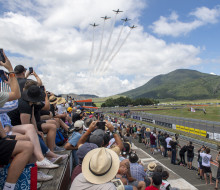
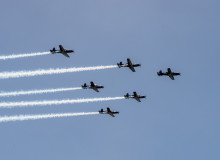
One of the most public roles of CFS is the formation and display work carried out by the RNZAF's only aerobatic team. Using Harvards, the RNZAF first flew display aerobatics in the immediate post-WWII years. In 1967 the CFS team was officially called the 'Red Checkers', the name being derived from the red and white checkered cowls on the five Harvards that made up this team.

The Red Checkers team performed annually until 1973 when an international fuel crisis lead to their disbanding. In 1980 the team was reformed, this time with the CT-4B Airtrainer. The first Airtrainer team comprised four aircraft, but this was soon increased to the current team size of five aircraft, which allows for an integrated solo routine as part of the display.

The CT-4B Airtrainer had only limited power which made close formation flying required for displays a big challenge to the pilots. However, despite this limitation the Red Checkers teams built up an impressive reputation for precision displays flying at times with only 1.5 metres separation between wingtips. In 1999, the Red Checkers moved onto the new CT-4E Airtrainers. These aircraft have a much better performance which enables the team to provide displays of a bigger variety and with six aircraft in the formation. The wholly volunteer display team comprises pilots drawn from CFS with other QFI s from the Pilot Training Squadron supplementing as required. All practices for each summer season are carried out in spare time, normally before or after the normal workday routine.

The Red Checkers also boast an impressive safety record, which is due in large part to the fine work of the PTS maintenance team. The maintenance team often deploys with the display aircraft to provide away from home maintenance, and to man the static display aircraft, which is normally the reserve aircraft taken with the Red Checkers team.

For more information and up coming events please visit Air Shows and Open Days

Contact Address:


 The Commanding Officer
 CFS RNZAF
 RNZAF Base Ohakea
 Private Bag
 PALMERSTON NORTH
 N.Z.