Coalition Warrior Interoperability Demonstration (CWID)
Coalition Warrior Interoperability Demonstration (CWID) is an annual trial of command and control, communications, computer and intelligence (C4I) technology designed to identify clever industry solutions to military C4I problems. The demonstration is sponsored by the United States Department of Defence whose ultimate aim is to fast-track these solutions into service for immediate use by deployed personnel.
So far this all sounds like too many ones and zeros. A bit like the tangle of cables behind your desktop computer – don’t we pay other people to worry about things like that? The answer is yes, and no. While the Communications and Information Systems (CIS) branch is tasked with developing RNZAF C4I capability they can’t do this effectively unless they know what we need. Without crystal balls and Ouija boards they depend on us to tell them but what if we don’t know ourselves.
If you’ve been wrestling with STUPID_APPLICATION.EXE (version out-of-date) for ages then CWID provides an environment to trial alternatives without breaking business as usual in the process. Better still, as CWID is a multinational collaborative demonstration we also get to see and play with the solutions that our Allies are considering. This is invaluable knowledge that helps to ensure our networks and business processes can interoperate with those of our Allies.
Lawn Mowers and Blow-up Tents
Chief of Air Force, Air Vice Marshall Lintott issued his Directive for CWID 2007 in December 2006. The RNZAF aim for CWID 2007 is to expose as wide a range of RNZAF personnel as possible to current and emerging C4I technologies and the implications these technologies have for RNZAF involvement in Joint and Combined operations. In particular the RNZAF needs an increasing number of non-CIS aligned personnel to take part in CWID. Through experiencing the applications under trial those personnel will gain knowledge that will enable them to describe their everyday requirements in greater detail. Experience has shown that projects built on a foundation of solid user requirements have a greater chance of success.
In considering which trials we should participate in CAF directed the RNZAF to focus on two key areas: trials that will enhance Air C4I knowledge and/or contribute to the Joint Command and Control System (JCCS), and trials that support collaborative air operations planning.
Thunderbirds are Go!

OH-07-0350-15-tn.jpg: Portable Flight Planning System.
Network Enabled Capability developments and the JCCS will force NZDF elements to operate in a far more connected manner than they do at present. JEMS is quantum step forward for the RNZAF in supporting force elements and will continue to deliver new efficiencies as our people learn to exploit its potential. For planning and execution things are far less advanced.

OH-01-0432-18-tn.jpg: RNZAF Iroquois.
During CWID 2007 the RNZAF will collaborate with No. 3 Squadron to experiment with a number of planning tools and explore how these tools might be integrated with the Global Command and Control System which has been selected as the core for the JCCS. Among the tools being integrated are the Portable Flight Planning System (PFPS) and Command and Control to the PC (C2PC). Of particular interest is a plug-in to PFPS created by Collaboration Technologies that allows multiple users to plan the same mission simultaneously from separate locations.
Ensuring the Lawns get Mowed
The single dominating feature of every RNZAF operations room is the tasking board. Usually a large whiteboard decked out with innumerable magnetic strips and shapes detailing the next few months unit tasking. The tasking board is a hub of information that juggles squadron resources against upcoming tasks and training commitments. Some wives have even been known to refer to the tasking board to figure out when the lawns will next be mowed.
The accuracy of the tasking board depends on information from many sources to make sure that Johnny Crewmember isn’t programmed for his fitness test while at the same time serving drinks to passengers on an overseas flight. The RNZAF will examine the potential of three systems for managing Force Element activities: FlightPro by Ocean Software, Air Operations Centre by Jeppessen and our own home-grown Force Element Management System (FEMS) by the RNZAF Applications Support Unit.
A Bridge (hopefully) Not Too Far

OH-07-0350-21-tn.jpg: NH90 cockpit.
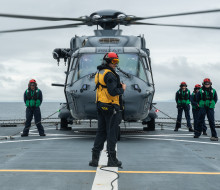
The step up in capability from the venerable Iroquois to the state-of-the-art NH90 will herald many changes in how No. 3 Squadron conducts business. The NH90 is capable of delivering vast amounts of information to crew members that is currently either written on a map or may not be available to the crew at all. Managing all this information requires careful consideration to ensure that crews are not overloaded or distracted at critical times.

OH-02-0281-31-tn.jpg: Two pilots flying a RNZAF Iroquois.
During CWID 2007 the RNZAF will begin to bridge the gap between the Iroquois and the NH90 by tackling the use of moving maps and C2 applications in the Iroquois and establishing basic network connectivity with the ground. It should be noted that in this particular experiment the primary aim is not to produce something that can be left in the aircraft for future operations. The aim instead is to develop tactics and operating procedures for using such information without compromising flight safety or mission effectiveness.
Steganography is not a Dinosaur!
Far from prehistoric, steganography refers to a modern technique where information is hidden in images so that it can be passed without notice. This is just one of the security risks that the NZDF must protect itself against. Another potential security risk is document metadata which refers to the information stored in documents that the user doesn’t see. This can include details of the author, the computer it was created on, document history and even things you’ve deleted. Metadata is the reason why simple documents seem to take up far too much disk space. During CWID 2007 the RNZAF will examine a number of applications designed to detect security risks and to automate the sanitisation of documents before release.
Who Ordered the Blow-up Tent?

OH-07-0350-18-tn.jpg: External view of a Defence Air Shelter manufactured in Auckland by Covertex.

OH-07-0350-19-tn.jpg: Internal view of a Defence Air Shelter manufactured in Auckland by Covertex.
The RNZAF operates globally – from Antarctica to East Timor; from Ohakea to Afghanistan. We go wherever the New Zealand Government directs us to get the job done – hoorah! Humans are very resilient in adapting quickly to new surrounds. The equivalent in equipment terms is MilSpec and costs an arm and two legs. Noting that computer equipment generally becomes obsolete after three years it is often difficult to justify the cost of MilSpec and therefore commercial-off-the-shelf is used instead. Computer equipment can be very sensitive to extremes of cold, heat, dust and moisture so to protect our investment the RNZAF is trialling the Defence Air Shelter manufactured in Auckland by Covertex. This inflatable tent is fully sealed and with the addition of an air conditioner, is designed to keep the weather out.

OH-07-0350-16-tn.jpg: Coalition Warrior Interoperability Demonstration (CWID) logo.
Where is all this happening?
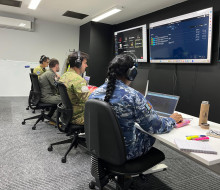
CWID 2007 will be conducted at RNZAF Base Ohakea in the old Airways radar room.
When can I see some cool stuff?
Day and night activities will be occurring over the period 11-22 June. A visit programme will be promulgated in routine orders.
Where can I get more information?
Go to the Intranet Launch Pad and click HQNZDF then CWID