Print Header

Mischief and Comradeship - Kiwi WWII Stories Celebrated

Flight Lieutenant Chris De Marco

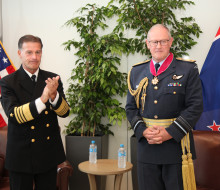
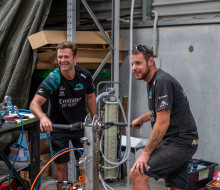
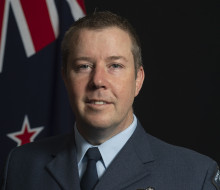
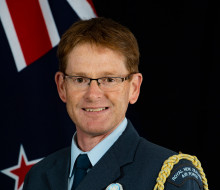
FLTLT Russell Simons and FGOFF Mark Chadwick, represent the airmen of today at the historic Bomber Command gathering. WN-07-0035-99-tn.jpg.
FLTLT Simons and FGOFF Chadwick, represent the airmen of today at the historic Bomber Command gathering. WN-07-0035-99-tn.jpg.

Tales that are only shared among fellow aircrews were the highlight of a gathering in Auckland recently.

During WWII several young Kiwis were attached to the RAF as part of Bomber Command as pilots, navigators, wireless operators, bomb aimers and gunners. They operated from Bases in Britain and fought in campaigns, including those over the Ruhr Valley, Stuttgart, Berlin and Kiel.

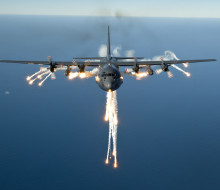
Eleven kiwi veterans, representatives of Bomber Command and relatives of Maori who served in Bomber Command, were honoured in a ceremony held at MOTAT and attended by Prime Minister Helen Clark in June 2007. As the P-3K Orion is the only aircraft in RNZAF service capable of deploying tactical weapons, Number 5 Squadron was invited to be part of the ceremony.

The gathering was part of a documentary on Bomber Command being filmed for Maori Television. The documentary is inspired by a book by Max Lambert, Night after Night.

As part of a 5 Squadron crew led by WGCDR Logan Cudby, I attended a ceremony that consisted of a powhiri to honour the veterans, followed by a meet and greet with Helen Clark.

The powhiri and ceremony was held at Auckland’s Museum of Transport and Technology. WN-07-0038-04-tn.jpg.

The P-3 airmen and women were privileged to hear authentic tales of horror and of happiness.

Even a youthful rendition of the tail gunners’ song was sung to our own Sergeant Michelle Charlton.

As part of the documentary, the P-3 crew members were interviewed alongside their counterparts from Bomber Command.

Although you would expect that the standard questions like ‘why did you join the Air Force?’ would bring a different response from the veterans, the answers actually surprised me.

One vet answered ‘it was join the Air Force or go to university’. Another just said ‘I wanted to fly’.

One question asked by the interviewer stood out as being a little bit more significant to me than the others.

“What is the difference between the role you have now and the role the vets had?”

The face of today’s equivalent of Bomber Command personnel. WN-07-0038-01-tn.jpg.
The face of today’s equivalent of Bomber Command personnel, L-R: Wing Commander Cudby, SGT Wraight, FLTLT De Marco, SGT Charlton, Flying Officer Chadwick, W/O Donnellan, FLTLT Simons and SGT Jackson. WN-07-0038-01-tn.jpg.

As I stood there somewhat dumbfounded by the question, wondering how the interviewer could try to compare WWII with now, I was saved by Warrant Officer Donnie Donnellan who summed up my thoughts of the whole afternoon exactly – “it’s not the differences that have stood out, it’s the similarities.”

Although many of the stories involved the war and all the atrocities that war brings, many stories were stories of mischief, comradeship and of chasing the ladies - stories of young men and women being young men and women.

These stories would not be out of place in any mess or on any Base around New Zealand today.

A great lark recalled how some lads ‘borrowed’ fuel from an aircraft to get a car into town and how they avoided the fuel test given by Air Security while leaving Base. Another memory laughed over was about being bought drinks by a group of ladies in a bar because of their uniforms.

There were many historical stories that you won’t hear in our messes. These included the Lancaster bomber being so heavy that shortly after takeoff the hedges at the end of the runway were trimmed by its four propellers.

There were stories of being shot down and baling out. One of the veterans told us about a time he was in a Lancaster and the tail was on fire. When he saw the pilot coming down to the back he said “hey, there’s a fire back here.” The pilot replied “there’s one up here too, now get out!”

L-R: Philip Farrow (Mosquito Squadron Leader), Jim McQueen (wireless operator), Harold ‘Bunny’ Burrows (navigator) and Ron Noice (bomb aimer). WN-07-0038-03-tn.jpg.

Wing Commander Bill Simpson (retired) tells a story of returning from a mission in his Mosquito aircraft at night and being fired upon by friendly forces over London.

Understandably upset by the event, WGCDR Simpson found the controller responsible to give him a piece of his mind - only to be told that they were not shooting at him, they were shooting at the JU88 that was on his tail. The friendly forces missed both of them.

As we were leaving and saying our farewells one veteran pointed to the rank on my arm and asked “what rank is that? “Flight Lieutenant” I answered.

“Oh, I finished the war as a Flight Lieutenant,” he replied.

“I got shot down as a Sergeant and returned as a Flight Lieutenant - the back pay bought me a farm when I got back to New Zealand!”

The veterans from Bomber Command are getting older physically but they are still young airmen at heart.

It was an absolute honour to spend the afternoon among them and hear stories that you couldn’t even read about.

The documentary is scheduled to screen on Maori Television in 2008.